
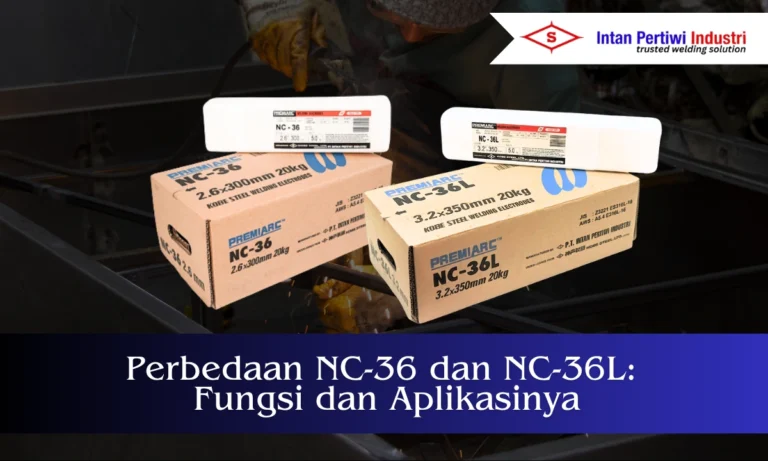
It is important to understand the differences between NC-36 and NC-36L before selecting a welding electrode for stainless steel applications. While both are used for welding 316-grade stainless steel, they differ in terms of AWS classification, carbon content, base materials, and resistance to post-weld corrosion.
In fabrication, manufacturing, and maintenance operations involving stainless steel components—such as tanks and piping—selecting the right electrode significantly impacts the quality of the weld joint. Choosing the wrong welding electrode can lead to suboptimal weld results, particularly in applications requiring superior corrosion resistance.
In general, NC-36 is used for Type 316 stainless steel, whereas NC-36L is used for Type 316L stainless steel, which requires a weld deposit with a lower carbon content.
For other stainless steel welding needs, you can also explore various options for stainless steel welding electrode tailored to specific material types and work applications.
What Is NC-36?
NC-36 is a stainless steel welding electrode classified as AWS A5.4 E316-16. It is used for welding Type 316 stainless steel where good corrosion resistance is required, particularly in environments involving moisture, mild chemicals, or general industrial applications.
NC-36 is a type of SMAW electrode, or stick electrode. It is widely used in fabrication and repair work due to its practicality and versatility, and is suitable for a variety of stainless steel welding applications.
What Is NC-36L?
NC-36L is a stainless steel welding electrode classified as AWS A5.4 E316L-16. The letter “L” in NC-36L stands for "low carbon." This means the electrode is designed to produce a weld deposit with a lower carbon content compared to the standard E316 type.
Due to its lower carbon content, NC-36L is better suited for Type 316L stainless steel or applications requiring superior resistance to intergranular corrosion after welding. This grade is frequently chosen for projects demanding consistent weld joint quality in corrosive environments.
Differences between NC-36 and NC-36L
1. Differences in AWS Classifications
The first difference between the NC-36 and NC-36L lies in the AWS classification.
NC-36 has the AWS A5.4 E316-16 classification, whereas NC-36L has the AWS A5.4 E316L-16 classification. The code “E316” indicates a type 316 stainless steel electrode, while “E316L” indicates the type 316L variant with lower carbon content.
For the NC-36L, the letter "L" serves as the primary indicator that this electrode is a low-carbon type. This distinction is significant because carbon content affects the durability of the weld, particularly in applications at risk of sensitization or intergranular corrosion.
2. Differences in Welded Materials
NC-36 is used for welding Type 316 stainless steel. This material is commonly used in various industrial applications due to its good corrosion resistance, resulting from its chromium, nickel, and molybdenum content.
Meanwhile, NC-36L is used for welding type 316L stainless steel. 316L stainless steel has a lower carbon content than standard 316, making it more suitable for applications requiring superior corrosion resistance after welding.
In other words, if the material to be welded is 316 stainless steel, NC-36 is a suitable choice. However, if the material used is 316L stainless steel or the job requires a low-carbon weld deposit, NC-36L is recommended.
3. Difference in Carbon Content
The difference in carbon content is one of the most important factors distinguishing NC-36 from NC-36L.
NC-36 has a carbon content of approximately 0.04%, with a guaranteed limit of ≤0.08%. Meanwhile, NC-36L has a lower carbon content of approximately 0.03%, with a guaranteed limit of ≤0.04%.
The lower carbon content of NC-36L helps reduce the risk of chromium carbide formation in the weld area. This is important because chromium carbide can impair the corrosion resistance of stainless steel, particularly in the heat-affected zone surrounding the weld joint.
4. Difference in Corrosion Resistance
NC-36 offers good corrosion resistance for welding 316 stainless steel. This electrode is suitable for a wide range of general industrial applications involving stainless steel that require strong welds capable of withstanding mild to moderately corrosive environments.
However, NC-36L offers an advantage in applications requiring superior resistance to intergranular corrosion. Due to its lower carbon content, NC-36L helps reduce the risk of sensitization after welding.
This makes NC-36L more suitable for stainless steel work involving corrosive environments, specific operating temperatures, or applications requiring more stable long-term joint performance.
5. Application Differences
NC-36 is suitable for general 316 stainless steel applications. Examples include fabrication, manufacturing, stainless steel component repair, light-to-medium construction, and industrial maintenance requirements.
NC-36L is best suited for 316L stainless steel, particularly in applications requiring superior corrosion resistance. This electrode is suitable for use on stainless steel tanks and piping, chemical industry equipment, components in marine environments, and other applications requiring low-carbon weld deposits.
If your work requires a choice of welding electrodes for stainless steel, the selection between NC-36 and NC-36L should be based on the material type, working environment conditions, and the required joint quality standards.
Functions of NC-36 and NC-36L in Stainless Steel Welding
The primary function of the NC-36 is to facilitate the welding of 316 stainless steel, producing joints that are strong, stable, and possess good corrosion resistance. This electrode is suitable for welding 316 stainless steel when there is no specific requirement for low carbon content.
Meanwhile, the primary function of NC-36L is for welding 316L stainless steel or for applications requiring low-carbon weld deposits. NC-36L helps maintain corrosion resistance in the weld zone, particularly in applications at risk of intergranular corrosion following the welding process.
When Should You Use NC-36?
Use NC-36 when welding Type 316 stainless steel and the job does not specifically require a low-carbon weld deposit. This electrode is suitable for general stainless steel applications requiring welds with good corrosion resistance.
The NC-36 is also a suitable choice for fabrication, maintenance, and industrial work involving 316 stainless steel in environments ranging from normal to moderately corrosive.
When Should You Use the NC-36L?
Use NC-36L when the material to be welded is Type 316L stainless steel or when the application requires superior resistance to intergranular corrosion. NC-36L is better suited for applications requiring low-carbon weld deposits.
NC-36L is also recommended for stainless steel applications in more corrosive environments—such as the chemical industry, marine areas, tanks, piping, and equipment—that require superior corrosion resistance after welding.
Conclusion
The main differences between NC-36 and NC-36L lie in their classification, the type of stainless steel welded, carbon content, corrosion resistance, and applications. NC-36 is classified as AWS A5.4 E316-16 and is used for 316 stainless steel, whereas NC-36L is classified as AWS A5.4 E316L-16 and is used for 316L stainless steel or for applications requiring a low-carbon weld deposit.
If your work generally involves 316 stainless steel, NC-36 is a suitable choice. However, if the material used is 316L stainless steel or the application requires higher corrosion resistance after welding, NC-36L is the more appropriate choice.
PT Intan Pertiwi Industri has been a manufacturer of Kobelco welding electrode since 1977, with extensive experience in supplying a wide range of high-quality welding electrodes to industries in Indonesia.
To receive product recommendations tailored to your project's needs, please do not hesitate to contact our team. We are ready to assist you in selecting the best welding electrodes to ensure optimal results that meet industry standards.