
In the industrial world, wear and tear on working components is an unavoidable challenge. Metal surfaces that are constantly rubbed, impacted, or exposed to abrasion will experience a decline in performance over time.
If left untreated, this condition can accelerate damage, disrupt productivity, and increase maintenance and part replacement costs. This is where hardfacing welding electrode becomes a much-needed solution.
Hardfacing welding electrode is used to form a hard layer on the metal surface to make it more resistant to wear, impact and work pressure.
This method is widely chosen by industrial players because it can help extend the service life of components without having to always replace parts with new ones.
By selecting the right hardfacing electrode, companies can maintain operational efficiency while reducing maintenance costs in the long term.
Table of Content
ToggleWhat is Hardfacing Welding Electrode?
Hardfacing welding electrode is an electrode or welding material designed to coat metal surfaces with a metal deposit that has a higher level of hardness and wear resistance than the base material.
The main goal is not just to join two materials, but to build a protective layer on the work area that is prone to wear.
In practice, hardfacing is widely used for three main purposes:
- Build-up: rebuilding a component part that has been eroded.
- Repair: repairs the surface of a component so that it can be reused.
- Wear-resistant coating: adds a protective layer to the surface to make it more resistant to abrasion, friction, and impact.
The fundamental difference between hardfacing and conventional welding electrode lies in their intended use. Conventional welding electrode is generally used for joining materials, while hardfacing is focused on improving surface durability.
Therefore, selecting a hardfacing product is not the same as selecting a general welding electrode. Each application requires different deposit characteristics, hardness levels, and durability.
When is Hardfacing Welding Electrode Needed?
The use of hardfacing welding electrode becomes very important when working components begin to show signs of wear due to harsh operational conditions.
In many industrial sectors, components not only work under high loads, but also face constant friction, impact and contact with abrasive materials.
Hardfacing is necessary when a component's surface experiences abrasion, for example due to contact with sand, rock, soil, minerals, or other abrasive materials. This condition is common on excavator buckets, crushers, blades, and various heavy equipment components.
In addition, hardfacing is also needed when metal-to-metal friction occurs, namely direct contact between metal surfaces which causes the surface to erode quickly.
In situations like this, a hardfacing layer helps increase the durability of the component so that it does not wear out quickly.
In certain applications, work tools are often subjected to impacts. Not all hardfacing electrodes are suitable for these conditions. A product is required that is not only hard but also has deposit characteristics that can withstand mechanical stress without easily cracking.
From a business perspective, the use of hardfacing welding electrode is also a strategic choice when companies want to reduce spare part replacement costs.
By rebuilding or re-coating, components can be used for longer, thus making operational costs more efficient.
Types of Wear to Understand Before Choosing Hardfacing Welding Electrode
One of the most important steps before selecting a hardfacing welding electrode is understanding the type of wear that has occurred on the component. Misidentifying the type of wear can lead to selecting the wrong electrode, resulting in suboptimal coating results.
Abrasion
Abrasion occurs when a metal surface rubs against hard particles such as sand, rock, ore, soil, or other abrasive materials. This type of wear is a major cause of surface damage in various industrial sectors, particularly mining, construction, and manufacturing.
Due to its nature of constantly eroding the work surface, abrasion needs to be overcome with hardfacing welding electrode which is specifically designed to provide a wear-resistant coating.
Metal-to-Metal Wear
Metal-to-metal wear occurs when two metal surfaces rub against each other during operation. This condition is often found on shafts, sprockets, rollers, and various other mechanical transmission components.
If not handled with the right electrodes, the component surface can quickly thin, deform, and experience decreased performance.
Impact or Clash
Impact occurs when a component receives a blow, shock load, or repeated mechanical stress during use.
In these conditions, components require not only a hard coating but also a weld deposit that is resistant to cracking. Therefore, selecting a hardfacing welding electrode for impact applications must consider the balance between the hardness and toughness of the deposit material.
Heat Wear or Wear in Heavy Work Environments
Heat wear is a type of wear that occurs under heavy operational conditions accompanied by high temperatures or certain working pressures.
While this isn't the case for all applications, it's still important to consider this, especially in industries with extreme working environments. In such cases, the choice of hardfacing electrode must be tailored to the temperature and workload requirements to ensure a stable and durable weld layer.
Hardfacing Welding Electrode Options from KOBELCO
As a company that provides welding products for industrial needs, Intan Pertiwi Industri presents several choices of KOBELCO hardfacing welding electrode that can be adjusted to work conditions in the field.
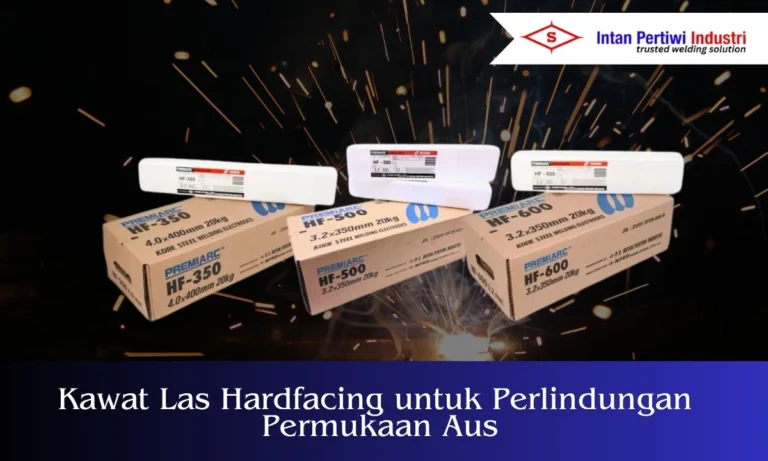
Three products that are the choice for hard coating needs are HF-350, HF-500, and HF-600.
Each product is designed for different application needs. Therefore, selecting a product requires more than just looking at the hardness number; it must also consider the type of wear, component type, and coating purpose.
1. HF-350 Welding Electrode
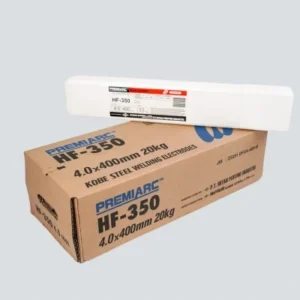
HF-350 is the right choice for resurfacing and wear resistance enhancement needs on work surfaces that require a balance between hardness and workability.
This product produces a pearlite type deposit with a hardness level of around Hv 350, and has a weldability range of around 200–400 Hv.
These characteristics make HF-350 suitable for applications requiring high metal-to-metal wear and impact resistance without compromising fracture resistance. Furthermore, this product boasts excellent machinability, making it more versatile for various repair and buildup applications.
Some examples of applications suitable for the HF-350 include bulldozer track rollers, sprockets, bucket teeth, shafts, top wheels, and heavy equipment saw chains.
For industries that require a rebuild solution with stable performance and a more controlled risk of cracking, the HF-350 is an option worth considering.
2. HF-500 Welding Electrode
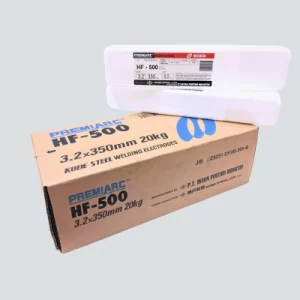
For higher abrasion surface protection requirements, HF-500 may be a more suitable choice.
This product is a hardfacing welding electrode designed to withstand wear and tear caused by friction on hard materials. HF-500 produces a deposit hardness of approximately 500 HB, with a weldability guideline range of 350–800 Hv.
Due to these characteristics, HF-500 is suitable for use on components operating under moderate to severe abrasion. This product can be applied to excavator buckets, crushers, cutting blades, and various components experiencing high friction.
In addition to offering abrasion protection, HF-500 also offers application advantages, such as good arc stability, low spatter, and relative ease of use. This contributes to a more comfortable welding process and promotes consistent deposition results in the field.
3. HF-600 Welding Electrode
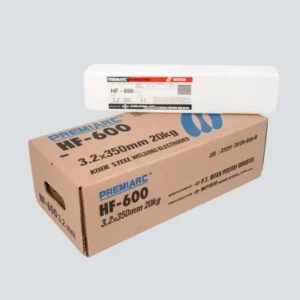
For more extreme needs, HF-600 is available as a hardfacing welding electrode option with a higher level of hardness.
This product is designed for demanding applications that face intense abrasion and impact in the work area. HF-600 produces a hardness of approximately 55–60 HRC, making it suitable for use in components with high-performance requirements.
Suitable applications for the HF-600 include excavator buckets, bulldozer blades, crusher plates, and various heavy machinery components.
This product is relevant for industries such as mining, construction and heavy manufacturing, where components often work in highly abrasive environments.
With its hard deposit character and resistance to heavy working conditions, HF-600 is the choice for companies that require more aggressive surface protection to extend the service life of critical components.
Comparison of HF-350 vs HF-500 vs HF-600
In general, HF-350, HF-500, and HF-600 have different application focuses. HF-350 is better suited for build-up, repair, and applications requiring good crack resistance and machinability. This product is ideal for certain metal-to-metal wear and impact conditions.
Meanwhile, HF-500 is at the intermediate level for moderate to severe abrasion protection. This product is suitable for components that encounter heavy contact with hard materials and require a more wear-resistant surface than standard build-up.
On the other hand, the HF-600 is intended for more demanding working conditions, especially when components face high abrasion and impact in extreme operations.
In terms of hardness, HF-600 is above HF-350 and HF-500, but that doesn't mean it's always the best choice for all conditions.
Therefore, choosing a hardfacing welding electrode should not be based solely on hardness. The most appropriate product is the one that best suits the component's operating conditions, wear type, and intended application.
Get a Quote on Hardfacing Welding Electrode
If you are looking for hardfacing welding electrode for repair, build-up, or wear-resistant coating on industrial components, Intan Pertiwi Industri provides a selection of products that can be tailored to your application needs.
You may consider:
- HF-350 for good build-up and crack resistance,
- HF-500 for moderate to heavy abrasion,
- and HF-600 for abrasion and heavy impact in extreme working conditions.
To get a more appropriate solution, contact the Intan Pertiwi Industri team and consult your application needs.
By selecting the appropriate product, the maintenance process can be more efficient and the service life of components can be increased more optimally.
What is the function of hardfacing welding electrode?
The primary function of hardfacing welding electrode is to coat metal surfaces to increase resistance to wear, abrasion, friction, and impact. Hardfacing is also used for build-up and repair of eroded components.
What is hardfacing welding electrode used for?
Hardfacing welding wire is used to protect or rebuild the surfaces of industrial components that wear quickly, such as excavator buckets, crusher parts, bulldozer blades, sprockets, shafts, and other heavy equipment components.
What is the difference between HF-350, HF-500, and HF-600?
The main differences lie in the deposit characteristics and application focus. HF-350 is suitable for good build-up and crack resistance, HF-500 is suitable for moderate to severe abrasion, and HF-600 is intended for severe abrasion and impact under more extreme working conditions.
Which hardfacing welding electrode is suitable for excavator bucket?
For excavator buckets, the choice of hardfacing welding wire depends on the degree of wear. If the application is predominantly subject to moderate to heavy abrasion, HF-500 may be an option. If the working conditions are more extreme with higher abrasion and impact, HF-600 is more worthy of consideration.
Can hardfacing be used to repair worn components?
Yes, hardfacing is very commonly used to repair worn components. With the right technique and electrode selection, component surfaces can be rebuilt and coated to improve their durability under future operating conditions.