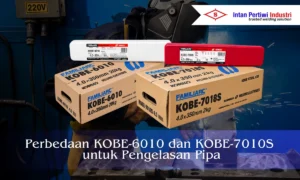
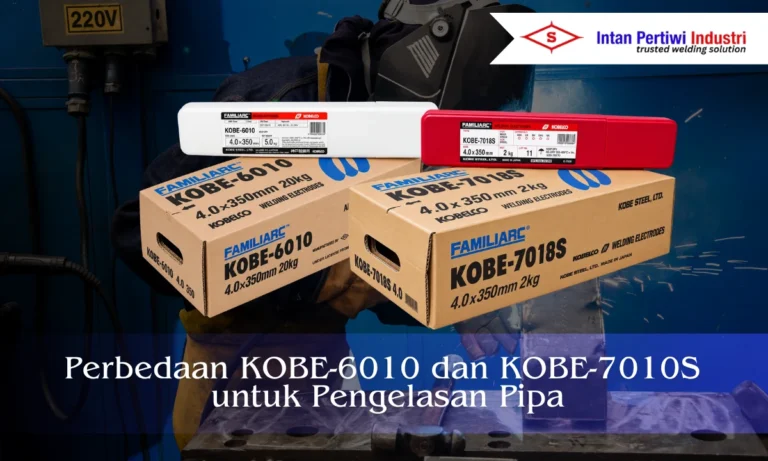
What is the difference between the KOBE-6010 and KOBE-7010S, and how do you determine the right electrode for pipe welding applications?
Although both are KOBELCO SMAW electrodes widely used for pipe welding and compatible with vertical-down welding techniques, KOBE-6010 and KOBE-7010S differ significantly in terms of AWS classification, weld metal strength class, mechanical properties, chemical composition, welding parameters, and recommended applications.
Understanding the characteristics of each product helps ensure that the selected electrode aligns with the material, WPS, and project technical requirements.
Table of Content
ToggleDifferences between KOBE-6010 and KOBE-7010S
KOBE-6010 and KOBE-7010S are stick electrodes for the SMAW (Shielded Metal Arc Welding) process, designed for welding butt joints on pipes.
Both also offer excellent performance characteristics for vertical downward welding and use DCEP polarity.
Despite having similar applications, the two differ in terms of AWS classification, weld metal strength, chemical composition, and current parameters, as well as recommendations for use with specific pipe grades.
Understanding the differences between KOBE-6010 and KOBE-7010S is important to ensure the electrode used aligns with the material, required joint strength, Welding Procedure Specification (WPS), and project requirements.
1. Differences in AWS Classifications
The most fundamental difference lies in the AWS classification of each electrode.
- KOBE-6010: AWS A5.1 E6010
- KOBE-7010S: AWS A5.5 E7010-P1
KOBE-6010 is classified as E6010 under AWS A5.1, whereas KOBE-7010S uses the E7010-P1 classification under AWS A5.5.
This classification difference relates to the mechanical strength requirements and weld metal characteristics that each electrode must meet.
Due to their different classifications, KOBE-6010 and KOBE-7010S should not be considered interchangeable simply because both are used for pipe welding.
2. Electrode Strength Class Differences
Based on its AWS classification, KOBE-6010 falls into the minimum tensile strength class of approximately 60 ksi, while KOBE-7010S falls into the class of approximately 70 ksi.
KOBELCO data shows:
| Product | Classification | Tensile Strength Minimum |
|---|---|---|
| KOBE-6010 | AWS A5.1 E6010 | 414 MPa |
| KOBE-7010S | AWS A5.5 E7010-P1 | 483 MPa |
Thus, the KOBE-7010S has a higher minimum weld metal tensile strength requirement compared to the KOBE-6010. However, the selection of the electrode must still adhere to joint requirements and the WPS, rather than simply choosing an electrode with a higher strength rating.
3. Difference in Yield Strength
The next difference is observed in the 0.2% yield strength (YS) of the all-weld metal.
| Product | Typical Value | Collateral Value |
| KOBE-6010 | 430 MPa | ≥331 MPa |
| KOBE-7010S | 470 MPa | ≥414 MPa |
KOBE-7010S has a typical yield strength of 470 MPa, while KOBE-6010 has a typical value of 430 MPa. The guaranteed value for KOBE-7010S is also higher—a minimum of 414 MPa compared to a minimum of 331 MPa for KOBE-6010.
This difference demonstrates that the KOBE-7010S weld metal is designed to meet a higher yield strength level.
4. Difference in Tensile Strength
The difference in tensile strength is one of the key technical distinctions between KOBE-6010 and KOBE-7010S.
| Product | Typical Tensile Strength | Collateral Value |
| KOBE-6010 | 510 MPa | ≥414 MPa |
| KOBE-7010S | 570 MPa | ≥483 MPa |
KOBE-6010 produces a typical all-weld metal tensile strength of 510 MPa, whereas KOBE-7010S achieves 570 MPa. Based on this data, KOBE-7010S possesses a higher weld metal tensile strength.
This difference is one of the reasons why the two products have different AWS classifications.
5. Weld Metal Elongation Difference
In addition to strength, the mechanical characteristics of the two electrodes can also be compared through elongation values.
| Product | Typical Elongation | Collateral Value |
| KOBE-6010 | 27% | ≥22% |
| KOBE-7010S | 30% | ≥22% |
The KOBE-7010S has a typical elongation of 30%, slightly higher than the 27% of the KOBE-6010. Nevertheless, both share the same minimum guaranteed elongation value of 22%.
For impact values at temperatures -29°C, KOBELCO lists typical values of 63 J for the KOBE-6010 and 61 J for the KOBE-7010S, with the same minimum guaranteed value of 27 J.
Therefore, it is not accurate to say that KOBE-7010S excels in all mechanical parameters; its main advantages lie in its higher yield strength and tensile strength.
6. Differences in Weld Metal Chemical Composition
The chemical composition of the all-weld metal also shows some differences between KOBE-6010 and KOBE-7010S.
| Element | KOBE-6010 Typical | KOBE-7010S Typical |
| C | 0,12% | 0,14% |
| Si | 0,15% | 0,10% |
| Mn | 0,51% | 1,01% |
| P | 0,009% | 0,01% |
| S | 0,008% | 0,01% |
| Ni | 0,02% | 0,01% |
| Cr | 0,02% | 0,02% |
| Mo | <0,01% | <0,01% |
| V | <0,01% | <0,01% |
The most noticeable difference lies in the manganese (Mn) content . KOBE-6010 has a typical Mn content of 0.51%, while KOBE-7010S has a typical Mn content of 1.01%. The typical carbon content of KOBE-7010S is also slightly higher, at 0.14% compared to 0.12% in KOBE-6010.
Data komposisi tersebut merupakan komposisi all-weld metal, sehingga sebaiknya tidak disamakan dengan komposisi kimia kawat inti atau base metal.
7. Differences in Welding Current Parameters
KOBE-6010 and KOBE-7010S are available in diameters of 2.4 mm, 3.2 mm, 4.0 mm, and 4.8 mm, but the welding current recommendations provided by KOBELCO are not exactly the same.
KOBE-6010 Parameters:
| Diameter | Welding Current |
| 2,4 mm | 40–75 A |
| 3,2 mm | 70–130 A |
| 4,0 mm | 90–180 A |
| 4,8 mm | 140–225 A |
For the KOBE-6010, KOBELCO specifies that range for positions 1F, 1G, 2G, 3G uphill, 3G downhill, and 4G.
KOBE-7010S Parameters:
| Diameter | 1F, 1G, 2G | 3G Uphill, 4G | 3G Downhill |
| 2,4 mm | 40–70 A | 40–70 A | 40–70 A |
| 3,2 mm | 60–120 A | 60–120 A | 70–120 A |
| 4,0 mm | 90–170 A | 80–160 A | 100–170 A |
| 4,8 mm | 130–210 A | 120–200 A | 150–210 A |
For the KOBE-7010S, the current range varies according to the welding position. For example, a 4.0 mm diameter electrode is recommended at 90–170 A for 1F, 1G, and 2G; 80–160 A for 3G uphill and 4G; and 100–170 A for 3G downhill.
Actual parameters in the field still need to be adjusted based on the WPS, electrode diameter, position, material thickness, joint preparation, and welding conditions.
8. Electrode Identification Color Differences
KOBELCO uses different identification colors to help distinguish between the two electrodes.
- KOBE-6010: primary identification color Yellowish Green
- KOBE-7010S: first identification color Brown and second Black
Both use DCEP (Direct Current Electrode Positive) polarity. KOBELCO also explains that high-cellulose electrodes such as the E6010 and E7010-P1 for pipe welding are designed for use with DCEP.
Thus, polarity is not a distinguishing factor between the two products; what differs is the identification color and the electrode classification.
9. Differences in Pipe Grade Applications
The differences between the KOBE-6010 and KOBE-7010S can also be seen in KOBELCO’s recommendations for pipeline girth welding.
In KOBELCO’s Technical Highlight on covered electrodes for girth welding:
- In the API 5L X42–X52, KOBE-6010 is listed for the root pass using the vertical downward technique.
- In the API 5L X56–X60, both KOBE-6010 and KOBE-7010S are listed as options for the root pass.
- For X56–X60, KOBE-7010S is also listed for hot pass, filler, and cap.
- In API 5L X65, KOBE-7010S and KOBE-8010S are listed for vertical downward root passes.
- In API 5L X70, KOBE-7010S and KOBE-8010S are also listed for vertical downward root passes.
This indicates that the applications of the two standards do indeed overlap for certain pipe grades. Therefore, it is inaccurate to categorize KOBE-6010 solely as “standard pipe” and KOBE-7010S solely as “high-strength pipe.”
The selection must take into account material grade, welding pass, required mechanical properties, welding procedures, and project specifications.
10. Differences in Selection Based on WPS and Project Requirements
Although the KOBE-6010 and KOBE-7010S are both suitable for butt welding of pipes and offer excellent usability for vertical downward welding, they have different classifications and mechanical properties.
In summary, the considerations are as follows:
- Select KOBE-6010 when WPS or specifications require the AWS A5.1 E6010 electrode.
- Select KOBE-7010S when WPS or the specifications require AWS A5.5 E7010-P1.
- Take note of the required yield strength and tensile strength of the joint.
- Match the electrode to the pipe grade and the welding pass being used.
- Use welding parameters in accordance with recommendations and the qualified WPS.
- Do not substitute E6010 with E7010-P1, or vice versa, based solely on similarities in the welding process or position.
In pipeline work, an electrode with higher strength is not automatically the more appropriate choice. Matching the consumables, base metal, welding procedure, and engineering requirements remains the basis for selection.
Conclusion
The differences between KOBE-6010 and KOBE-7010S primarily lie in the AWS classification, weld metal strength class, yield strength, tensile strength, chemical composition, current parameters, identification color, and recommendations for their use on specific pipe grades and welding passes.
KOBE-6010 is classified as AWS A5.1 E6010, with a typical yield strength of 430 MPa and a typical tensile strength of 510 MPa. Meanwhile, KOBE-7010S is classified as AWS A5.5 E7010-P1, with a typical yield strength of 470 MPa and a typical tensile strength of 570 MPa.
Both use DCEP, which is suitable for butt welding pipes, and offer excellent usability for vertical downward welding.
Since their technical characteristics and intended applications are not entirely the same, the choice between KOBE-6010 or KOBE-7010S should be based on the WPS, material specifications, pipe grade, welding passes, and mechanical properties required by the project.
Need more information about KOBE-6010, KOBE-7010S, or other KOBELCO welding electrode products?
Contact Intan Pertiwi Industri for product information and assistance in selecting the welding consumables that best suit your welding needs.