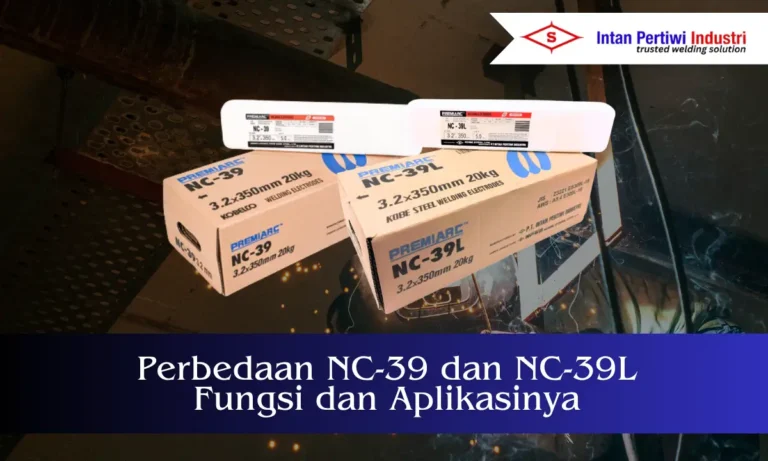
The main differences between NC-39 and NC-39L lie in their AWS classifications and the carbon content of the weld metal deposit. NC-39 has the AWS classification A5.4 E309-16, while NC-39L has the AWS classification A5.4 E309L-16. The letter “L” in NC-39L indicates that the product is a low carbon type.
Both electrodes belong to the E309 family and can be considered for welding dissimilar metal joints, including jobs involving ferritic steel or transitions between carbon steel and stainless steel. However, selection should not be based solely on the similarity of the product names.
The base material, filler material, low-carbon deposit requirements, operating environment, and the Welding Procedure Specification (WPS) must be reviewed before selecting the electrode to be used.
Table of Content
ToggleShort Answer
NC-39 is an SMAW electrode classified as AWS A5.4 E309-16, while NC-39L is classified as AWS A5.4 E309L-16. The letter “L” indicates a low-carbon deposit. Both can be used for dissimilar metal joints, but NC-39L is more appropriate when the WPS or project specifications require an E309L deposit with a lower carbon content.
What Is NC-39 Welding Electrode?
NC-39 is a KOBELCO stainless steel welding electrode for the Shielded Metal Arc Welding (SMAW) process. This product is classified as AWS A5.4 E309-16 and is designed for dissimilar metal joints and as a root pass on ferritic steel.
According to official KOBELCO data, the NC-39 can be used with either AC polarity or Direct Current Electrode Positive (DCEP). The recommended re-drying conditions are 150–200°C for 0.5–1 hour.
This electrode may be considered when the WPS specifies classification E309-16. Its use must still take into account the degree of mixing between the filler metal and the base material, or dilution, particularly in joints between stainless steel and carbon steel or low-alloy steel.
Technical information and complete specifications can be found on the KOBELCO NC-39 welding electrode page.
What Is NC-39L Welding Electrode?
NC-39L is a stainless steel electrode for the Shielded Metal Arc Welding (SMAW) process, classified as AWS A5.4 E309L-16. The letter “L” in the E309L classification indicates low carbon characteristics, meaning the weld metal deposit has a lower carbon content limit than the standard E309 type.
This electrode can be considered for welding dissimilar metal joints, such as carbon steel to stainless steel, as well as for use as a base coat or buffer layer on ferritic steel.
Its use must still be adapted to the base material, joint design, degree of dilution, and the applicable Welding Procedure Specification (WPS).
The KOBELCO NC-39L can be used with both AC and DCEP polarity. To maintain the condition of the electrodes before use, it is recommended to re-dry them at a temperature of 150–200°C for 0.5–1 hour.
Complete product specifications are available on the KOBELCO NC-39L welding electrode page.
Similarities Between NC-39 and NC-39L
Although they have different classifications, the NC-39 and NC-39L share a number of key similarities:
- Including stainless steel electrodes from the E309 series.
- Used in the SMAW welding process.
- Connections made of different metals may be considered.
- Can be used as a base coat on ferritic steel.
- Supports AC and DCEP polarity.
- It is recommended to re-dry at 150–200°C for 0.5–1 hour.
- Available for flat, horizontal, vertical-up, and overhead positions.
- The selection must be based on the base material and the WPS.
KOBELCO specifies different metal joint functions and underlaying for ferritic steel in both the NC-39 and NC-39L. Therefore, the main distinction between the two products is not merely the type of joint, but the classification and carbon limits of the weld metal deposit.
Differences Between NC-39 and NC-39L
1. Differences in AWS Classifications
NC-39 is classified as AWS A5.4 E309-16, while NC-39L is classified as AWS A5.4 E309L-16.
The addition of the letter “L” to E309L indicates a low-carbon variant. This distinction is important to note because electrode classifications are typically specified in the WPS or project specifications.
If the WPS specifies E309-16, the electrodes used must meet that classification. Conversely, if the document requires E309L-16, NC-39L is the product that meets that classification.
2. Differences in Carbon Content
KOBELCO data shows that the typical carbon content of NC-39 ore is 0.07%, while that of NC-39L is 0.04% in tests using AC current. The maximum guaranteed carbon content for NC-39 is listed as 0.15%, while that for NC-39L is limited to a maximum of 0.04%.
The lower maximum limit is the NC-39L’s key technical feature. This allows for better control of the deposit composition when the job requires the E309L grade.
Typical values are not figures that must always appear exactly the same in every welding result. The actual deposit composition can be influenced by dilution, electrode condition, welding parameters, base material, and the welder’s technique.
3. Differences in Risk Sensitization
In austenitic stainless steel, certain thermal cycles can promote the formation of chromium carbides around grain boundaries. This process can reduce the available chromium content in the surrounding area and increase susceptibility to intergranular corrosion.
In general, a lower carbon content helps reduce carbide precipitation caused by the heat input from welding. However, the use of low-carbon electrodes does not automatically guarantee a joint free from sensitization or intergranular corrosion.
Joint performance is also influenced by:
- Base material grade.
- Heat input.
- Interpass temperature or interpass temperature.
- Number of weld passes.
- Cooling rate.
- Dilution ratio.
- Operating environment.
- Cleaning after welding.
NC-39L is more appropriate when carbon deposit control is part of the technical requirements. NC-39 may still be used if the E309-16 classification is consistent with the WPS and the job conditions.
4. Differences in Usage and Application
Both NC-39 and NC-39L can be considered for welding dissimilar metal joints. Examples include joining stainless steel to carbon steel or using them as a base coat on ferritic steel.
NC-39 is more suitable when the job requires a standard E309-16 deposit. NC-39L should be considered when the specifications call for E309L-16 or require a deposit with a lower carbon limit.
When working with buffer layers, cladding, or transition layers, the selection of electrodes must take into account the final composition resulting from the mixing of the filler metal and the base material. Therefore, selecting based solely on the designations E309 or E309L is not sufficient.
5. Differences in Selection Criteria
NC-39L isn’t necessarily the best choice for every application. The low-carbon variant offers advantages when the carbon content of the deposit is a factor in joint design or corrosion resistance.
Conversely, the use of NC-39 may still be appropriate if the WPS specifies E309-16 and does not require a low-carbon filler.
The final selection should take the following into account:
- Classification of electrodes in WPS.
- Types and grades of base materials.
- The materials to be joined.
- Material thickness.
- Joint operating environment.
- Corrosion requirements.
- Post-welding heat treatment.
- Welding position.
- Current parameters.
- Inspection and certification requirements.
Comparison Table of NC-39 and NC-39L
| Aspect | NC-39 | NC-39L |
|---|---|---|
| Classification | AWS A5.4 E309-16 | AWS A5.4 E309L-16 |
| Welding Process | SMAW | SMAW |
| Carbon character | Standard E309 Type | Tipe E309 low carbon |
| Typical carbon deposits | 0,07% | 0,04% |
| Carbon credit cap | Maximum 0.15% | Maximum 0.04% |
| Polarity | AC and DCEP | AC and DCEP |
| Different metal joints | In accordance with the material and WPS. | In accordance with the material and WPS. |
| Ferritic steel base layer | It is worth considering. | It is worth considering. |
| Election Focus | E309-16 classification requirements | E309L-16 classification requirements and low-carbon deposit |
| Considerations for Sensitization | Controlled through material selection and procedures. | Lower carbon helps reduce risk in relevant conditions. |
| Final reference | Datasheet, material, and WPS | Datasheet, material, and WPS |
Note: The carbon content is based on KOBELCO welding rod data. The actual values in the weld may be affected by dilution and welding process conditions.
When Should NC-39 Be Used?
NC-39 may be considered when:
- WPS requires AWS A5.4 E309-16.
- An E309 electrode is required for joining dissimilar metals.
- The work requires a base layer on ferritic steel.
- Low-carbon type deposits are not required.
- The base materials and operating conditions have been assessed as suitable.
- Welding parameters are determined by the diameter and position used.
Before use, assess potential dilution and the characteristics of the base materials. For critical joints, the composition of the final deposit should be evaluated by a welding engineer.
When is the best time to use the NC-39L?
NC-39L can be considered when:
- WPS requires AWS A5.4 E309L-16.
- The job requires a low-carbon weld metal deposit.
- The joint involves carbon steel and stainless steel conforming to the E309L classification.
- The risk of sensitization needs to be controlled.
- A buffer layer is required before the subsequent coating.
- The operating environment requires the control of corrosion resistance after welding.
The use of NC-39L does not eliminate the need to control heat input, interpass temperature, material cleanliness, and welding parameters.
Panduan Memilih NC-39 atau NC-39L
| Condition or Need | Products to Consider | Notes |
|---|---|---|
| The WPS specifies E309-16. | NC-39 | Ensure compliance with the base material and welding procedures. |
| The WPS specifies E309L-16. | NC-39L | Suitable for low-carbon weld metal deposition requirements. |
| Different metal joints | NC-39 or NC-39L | Select based on electrode classification and mating material. |
| Base layer on ferritic steel | NC-39 or NC-39L | Evaluate the dilution level and the requirements for the next layer. |
| The risk of sensitization needs to be controlled | The NC-39L can be considered. | Heat input and welding procedures must still be controlled. |
| Classification not yet determined | Do not choose based solely on the product name. | Check the WPS or consult a welding engineer. |
| Critical applications or corrosive environments | Adhering to project specifications | Review the materials, WPS, and operating conditions. |
Practical steps before deciding on a product:
- Identify the base material grade.
- Inspect the masonry materials.
- Read the electrode classification in the WPS.
- Determine whether a low-carbon deposit is required.
- Check the requirements for post-weld heat treatment.
- Evaluate the corrosive environment or operating temperature.
- Use parameters appropriate for the diameter and position.
- Ensure the electrodes are stored and dried according to recommendations.
- Consult a welding engineer regarding critical connections.
Readers seeking a broader overview can consult the guide to selecting stainless steel welding electrode.
Mistakes to Avoid
1. Selecting based on name similarity
NC-39 and NC-39L appear almost identical, but their classifications and carbon deposit limits differ. The product code must be matched with the WPS and material specifications.
2. Regarding the letter “L” as merely a series code.
The letter “L” indicates a low-carbon characteristic. This distinction is directly related to carbon content limits and considerations regarding sensitization.
3. Assuming the NC-39L is always better
NC-39L is more relevant when low-carbon deposits are required. For applications specifying E309-16, NC-39 remains a suitable choice.
4. Ignoring masonry materials
Joining stainless steel to carbon steel results in a mixing of compositions. The selection of filler material must account for dilution to ensure the deposit structure does not become excessively hard or susceptible to cracking.
5. Did not follow the WPS
Parameters that prove successful for one job are not necessarily suitable for other materials, thicknesses, or positions. Current, polarity, number of passes, and interpass temperature must comply with approved procedures.
6. Using electrodes in damp conditions
KOBELCO recommends re-drying NC-39 and NC-39L at 150–200°C for 0.5–1 hour. Storage and drying must comply with the datasheet and consumable control procedures.
7. Neglecting surface cleanliness
Oil, paint, moisture, scale, and contamination from carbon steel tools can affect arc stability and deposit quality. Use special stainless steel cleaning tools if necessary.
Product Recommendations: NC-39 and NC-39L
For dissimilar metal joints requiring AWS A5.4 E309-16 classification, one electrode that can be considered is the KOBELCO NC-39.
This product is designed for dissimilar metal joints and buttering layers on ferritic steel. Selection must still be tailored to the base materials, welding procedure, and WPS.
If the job requires AWS A5.4 E309L-16 or weld metal deposits with lower carbon limits, KOBELCO NC-39L may be considered.
This product is also relevant for joining carbon steel to stainless steel, as well as for buffer layer requirements specified in the procedure.
The final compatibility of the two products must be confirmed through the official datasheet, base materials, joint design, operating conditions, and the project WPS.
Conclusion
The difference between NC-39 and NC-39L lies in their AWS classification and the carbon content of the weld metal deposit. NC-39 is classified as AWS A5.4 E309-16, whereas NC-39L is classified as AWS A5.4 E309L-16 and features a lower carbon limit.
NC-39 can be used when the job requires the standard E309-16 classification. NC-39L is more appropriate when the WPS specifies E309L-16, a low-carbon deposit, or the control of sensitization risks. However, the low-carbon nature does not eliminate the need to control heat input, dilution, cleanliness, and welding parameters.
PT Intan Pertiwi Industri supplies KOBELCO NC-39 and NC-39L for stainless steel welding and dissimilar metal joining applications.
Consult on the material type, work conditions, and WPS requirements to ensure the selected electrode meets project needs.

FAQs
What are the main differences between the NC-39 and the NC-39L?
NC-39 is classified as AWS A5.4 E309-16, whereas NC-39L is classified as AWS A5.4 E309L-16. The primary difference lies in the carbon content of the deposit. NC-39L has a lower carbon limit, making it more suitable when the WPS or project specifications require a low-carbon electrode.
What does the letter L in NC-39L stand for?
The letter "L" stands for "low carbon." For NC-39L, the guaranteed maximum carbon content is 0.04%. Lower carbon content helps reduce chromium carbide formation and the risk of sensitization under relevant conditions, but it does not guarantee a completely corrosion-free joint.
Is NC-39L always better than NC-39?
No. NC-39L is more suitable when the job requires E309L-16 or a low-carbon deposit. NC-39 remains appropriate when the WPS specifies E309-16. The selection should be based on classification, base material, operating environment, joint design, and project technical requirements.
Can NC-39 and NC-39L be used to join carbon steel with stainless steel?
Both are designed for dissimilar metal joints and buffer layers on ferritic steel. However, their use for joining carbon steel to stainless steel must be adapted to the material grades, dilution, heat treatment, operating conditions, and the approved WPS.
How do you choose between the NC-39 and the NC-39L?
First, check the electrode classification specified in the WPS. Use NC-39 if E309-16 is required, and NC-39L if E309L-16 or a low-carbon deposit is needed. Factors such as the base material, corrosive environment, heat treatment, welding position, and current parameters must also be taken into account.