
1F welding is one of the welding positions most commonly learned in the early stages of welding practice. This position is considered basic, yet it remains important because it serves as the foundation for understanding electrode angle control, arc stability, weld bead formation, and hand travel speed.
For beginners, learning 1F welding helps build neat and proper working habits from the start. For welders who already work in fabrication shops, this position also remains relevant because it is widely used for fillet joints in everyday work.
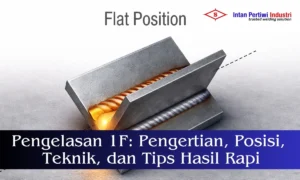
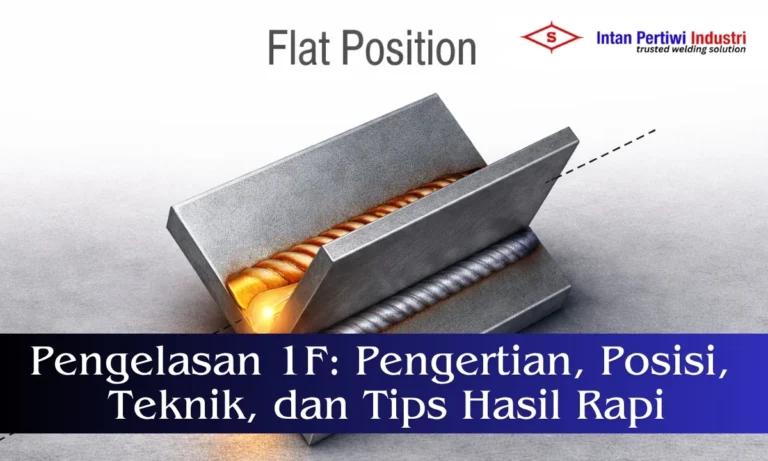
In practice, 1F welding generally refers to the flat fillet weld position. This means the weld is made on a corner joint, with the welding path performed in a position that is relatively easier to control than vertical or overhead welding.
Because the weld pool is more stable in this position, 1F is often used as the starting point for training weld bead quality, penetration, and welding consistency.
This article discusses the meaning of 1F welding, what the position looks like, how it differs from 1G, the basic techniques that need attention, common mistakes that often occur, and tips for choosing the right welding electrode for both practice and actual working applications.
Table of Contents
ToggleWhat Is 1F Welding?
1F welding is the flat fillet welding position. The number 1 indicates the flat position, while the letter F refers to a fillet weld, or corner joint weld.
So, when people talk about 1F welding, they do not simply mean welding in the lower position, but more specifically fillet welding on a flat joint orientation.
This position is widely used in basic SMAW training because it is relatively easy to observe and control.
Welders can focus more on bead formation, arc length, electrode angle, and hand stability without being overly burdened by gravity as in a vertical or overhead position.
What is the 1F Welding Position?
In welding position 1F, the workpieces typically form a corner joint. One plate is horizontal, while the other is at an angle to it. The weld line is then filled at the junction of the two materials.
Because the joint is flat, the weld pool tends to be easier to maintain. This makes 1F welding often considered the most beginner-friendly position. However, good results don't come automatically.
If the electrode angle is wrong, the amperage is too high, or the hand movement is unstable, the weld result can still be defective, for example undercut, not blending well, or the bead being too stacked.
Difference between 1F and 1G Welding
One common confusion is the equating of 1F and 1G welding. While both are flat, they are different types of joints.
1F welding is fillet welding or fillet welding. 1G welding is groove welding or seam welding.
In 1F, the focus is on filling the corners where two materials meet. In 1G, the focus is on joining two prepared edges with a specific seam shape.
This distinction is important because the techniques, penetration control, and how to read the weld shape are not completely the same.
So, when you are looking for references about 1F welding position, make sure the discussion is about fillet weld, not groove weld.
When is 1F Welding Used?
1F welding is widely used in basic welder training, vocational school practice, certification training, and light fabrication work.
This position also often appears in corner connection work for frames, supports, supports, and various light to medium steel construction needs.
For the learning world, the 1F position is very important because it helps participants understand the basics of welding before moving on to more challenging positions.
In the workplace, 1F welding remains useful because not all work involves difficult positions. Many joints can still be worked in advantageous positions, including 1F.
Basic Welding Techniques 1F for Beginners
Basic 1F welding techniques begin with preparation. The material surface must be free of rust, oil, paint, and other contaminants that could interfere with arc stability and melting quality. Afterward, tack weld sufficiently to prevent the joint from shifting during the welding process.
When starting to weld, the main focus is on three things, namely the electrode angle, arc length, and movement speed.
An electrode angle that's too tilted to one side can result in an uneven weld. An arc length that's too long will result in more spatter and difficulty forming a neat bead.
Conversely, if it's too short, the electrode can easily stick. Too fast a travel speed can cause underfilling, while too slow a travel speed can cause the weld bead to be too high and overheat.
In the beginning, 1F welding is safer when practiced with simple, steady movements. Not all joints require wide swings.
For many basic drills, a neat stringer bead is actually better because it helps beginners learn to control the weld path and shape more consistently.
Welding Ampere Setting 1F
In SMAW practice, the amperage setting for 1F welding isn't determined solely by position. Welding current is also affected by electrode diameter, electrode type, material thickness, and joint characteristics. Therefore, no single value is always correct for all conditions.
The ampere LB-52U guide indicates that the working current can vary depending on the diameter and welding position. For a 2.6 mm diameter, the range for the flat position is generally higher than for the vertical or overhead position.
This demonstrates an important basic principle, that a flat position such as 1F usually provides more room for stable current, as long as it adheres to electrode recommendations and material conditions.
If the amperage is too low, the arc will feel weak, the electrode tends to stick, and the metal fusion may be poor. If the amperage is too high, the weld pool becomes too fluid, spatter increases, and the weld bead can spread uncontrollably.
Therefore, for 1F welding, the best approach is to start from a safe range according to the electrode diameter, then adjust it gradually until the arc feels stable and the bead looks balanced.
Suitable Electrodes for 1F Welding
The selection of electrodes for 1F welding should be adjusted to the type of material, joint strength requirements, and job objectives.
For basic practice, a stable and easy to control welding electrode will help beginners achieve neater and more consistent weld results.
- Select a 1F welding electrode according to the material to be welded.
- For mild carbon steel, use an electrode with a soft, stable arc for easier control.
- RB-26 is suitable for basic training because it is known to have a smooth, stable arc and minimal sparks.
- If you need higher connection strength, low hydrogen electrodes can be an option.
- LB-52 can be considered for welding carbon steel and medium tensile steel.
- LB-52-18 is suitable for applications that require smooth welds, good penetration, and easy-to-clean slag.
- For welding practice 1F, choose an electrode that is easy to light and stable to make arc control easier.
- For work leading to construction or structural applications, low hydrogen electrodes are worth considering from the outset.
The Correct Way to Weld 1F
Correct 1F welding steps begin with material preparation, electrode selection, and appropriate amperage settings. With the correct work sequence, the weld will be neater, more stable, and easier to evaluate.
- Prepare the materials and ensure the joint area is clean of rust, oil, paint, and dirt.
- Select the appropriate electrode according to the type of material and the target welding result.
- Set the welding amperage based on the electrode diameter and joint characteristics.
- Create a tack weld to keep the workpiece in a stable position during the welding process.
- Light the bow calmly and keep the bow length consistent.
- Maintain the electrode angle so that melting is even on both sides of the joint.
- Move the electrode at a steady speed to form a neat bead.
- After a pass is completed, clean off the slag before continuing or evaluating the weld results.
- Check that the bead is symmetrical, the weld leg is sufficient, and there are no defects such as undercuts, porosity, or excessive buildup.
Common Mistakes During Welding 1F
Although considered a basic welding position, 1F welding still has several common mistakes that beginners often make. These errors usually relate to arc length, electrode angle, movement speed, and electrode condition.
- Inconsistent arc length can make the arc sound unstable and the weld result rough.
- An electrode angle that is too tilted to one side can cause the joint to fill unevenly.
- Too fast hand movements can result in thin and poorly integrated welds.
- Moving too slowly can cause excessive heat and the weld bead to be too large.
- Dirty material can reduce arc quality and increase the risk of weld defects.
- In low hydrogen electrodes, improper storage can affect welding performance.
- Ignored electrode re-drying can also reduce the quality of the weld in certain applications.
Tips for Tidy 1F Welding Results
To get neater 1F welding results, beginners need to focus on technical stability, material cleanliness, and selecting the right electrode.
Simple but consistent practice usually produces better results than techniques that are too forced from the start.
- Use clean practice material to make the bow more stable.
- Choose an electrode size that is comfortable to handle according to your capabilities and the type of work.
- Focus on stability of movement, not on speed.
- Pay attention to the sound of the welding arc as a steady sound usually indicates a more precise setting.
- If the electrode frequently sticks or the arc sound is intermittent, check the amperage and welding technique again.
- Practice short paths first until the bead shape is consistent.
- Once more stable, move on to longer weld lines.
- Don't rush into using wide swings if the basic control isn't yet solid.
- For low hydrogen electrodes, note the recommended electrode conditions, polarity, and amperage range.
- Use the classification and working position information on the product as a reference for selecting electrodes for 1F welding.
Is 1F Welding Suitable for Beginners?
Yes, 1F welding is perfect for beginners. This position provides an opportunity to learn the basics of welding in more manageable conditions.
Beginners can focus more on understanding the relationship between amperes, arc length, electrode angle, and the shape of the weld result.
However, just because it's suitable for beginners doesn't mean it should be taken lightly. Because 1F welding is fundamental, the quality of training at this stage is crucial for skill development in subsequent positions.
If the technical foundation in 1F is already neat, the learning process towards 2F, 3F, or other positions will usually be much more structured.
Conclusion
1F welding is an essential foundation for learning fillet welding. This position helps welders understand arc control, electrode angle, feed speed, and weld bead formation in relatively easy-to-learn conditions.
Even though it is a basic position, good results still depend on correct technique, appropriate electrode selection, and appropriate amperage settings.
Need to order SMAW welding wire for various welding needs? Contact the intanpertiwi.co.id team for consultation and product offers tailored to your needs.

FAQs
1. What is 1F welding?
1F welding is a fillet weld position performed flat. This position is commonly used for corner joints and is often the basis for welding training because it is easier for beginners to control.
2. What is the difference between 1F and 1G welding?
The difference between 1F and 1G welding lies in the type of joint. 1F is a fillet weld, while 1G is a groove weld.
3. Is 1F welding suitable for beginners?
Yes, 1F welding is suitable for beginners because the flat position allows for more stable weld pool. This position makes it easier to learn electrode angle, arc length, and travel speed.
4. What electrodes are suitable for 1F welding?
Electrodes for 1F welding are selected based on the material and work requirements. For basic training, a stable and easy-to-manage electrode is more suitable. For structural applications, low-hydrogen electrodes may be considered.
5. How to make 1F welding results neater?
To ensure a clean 1F weld, ensure the material is clean, use the correct amperage, maintain a consistent arc length, and move the electrode steadily. Short-path practice also helps.