
Welding cast iron often feels much more difficult than welding regular steel. When it comes to cast iron, the results are often disappointing: the weld bead appears to adhere, but the next day, fine cracks appear around the weld line.
This is understandable, as cast iron differs from steel. It has a high carbon content, tends to be brittle, and is very sensitive to sudden temperature changes.
This article discusses the correct way to weld cast iron from a field perspective: preparation steps, filler selection, heat control, welding techniques, and cooling methods to prevent cracking of the joint.
You will also find a specific guide on how to weld cast iron with electric arc welding (SMAW) as this method is the most commonly used in workshops.
If you are repairing a pump housing, engine mount, gearbox casing, block, flange, or other cast iron component, this guide can serve as a short, easy-to-follow SOP.
Table of Contents
ToggleWhy Does Cast Iron Crack Easily When Welded?
Untuk memahami cara mengelas besi coran, Anda perlu tahu penyebab retaknya:
To understand how high carbon and brittle structures
Cast iron generally has a higher carbon content than steel. When welded, the near-weld area (HAZ) can become harder and more brittle. cast iron glass, you need to know the causes of cracking:Thermal shock (high heat then rapid cooling)
Cracks often occur not during welding, but during cooling, especially if the component is allowed to cool rapidly in the presence of wind or water.Residual stress
Cast iron is not “forgiving” of stress. If the weld bead is too long, heat builds up, or stress relief techniques are lacking, cracks are more likely to develop.
Therefore, the correct way to weld cast iron is not just “gluing metal”, but managing heat and stress.
When to Weld, When to Braze or Other Repair
Not all cases need to be fully welded.
Welding is chosen when the component must be structurally strong again and its shape allows for heat control.
Brazing (e.g. bronze) is often chosen for thin components, complex areas, or very high risk of cracking.
Stitching/mechanical repair is sometimes safer for expensive components that cannot be distorted.
But if you really need to weld, proceed to the following 8 steps.
How to Weld Cast Iron Correctly and Safely
1. Evaluate the material and determine the strategy: cold weld or hot weld
There are two main approaches to welding cast iron:
Cold welding (without high heating)
Suitable for small components or areas that do not allow for even heating. The key is a short bead and gradual cooling.Hot welding (with preheat)
Suitable for thicker components, structural repairs, or long cracks. The key is even preheat and slow cooling.
When in doubt, the safest strategy is usually: conservative heat control, short bead times, and slow cooling.
2. Prepare the work area and PPE, then clean the surface until it is completely clean.
The most common mistake when welding cast iron is cleaning only the "surface," even though cast iron often absorbs oil through its pores.
Do this:
Use complete PPE: welding helmet, heat-resistant gloves, welding jacket, safety shoes.
Ensure the area is free of flammable materials and well ventilated.
Clean paint, rust, scale, and especially oil/grease (degreaser + grinding).
If the components are used in engines, do a light warm-up first to remove any oil residue, then clean them again.
Surfaces that still contain oil will trigger porosity and micro cracks.
3. Stop the crack from spreading: stop-drill and make a proper miter.
If you are welding cracked cast iron, do not immediately “seal the crack”.
Safer steps:
Crack tip stop-drill: a small drill at the tip of the crack to stop crack propagation when heated.
Create a V or U groove: grind the crack into a groove so that penetration is controlled and the weld metal can fill stably.
Leave enough small roots (not too thin) so that they don't easily "break" when hot.
This is an important part of how to properly weld cast iron, because cracks usually start from the tip of an active crack.
4. Select the appropriate electrode or filler for cast iron.
This is the biggest differentiating factor between welding cast iron vs. steel.
Common filler choices for cast iron:
Nickel (Ni) based electrodes for cast iron
Tend to be the safest for suppressing cracks and making work easier.Nickel-iron (Ni-Fe)
Often used for applications that require greater strength and better machining tolerances than pure nickel in some cases.Mild steel electrodes (as an emergency alternative)
Can be used if nickel is not available, but the risk is higher and requires additional techniques (e.g. buttering layer) to prevent cracking.
The principle: the more precise the filler, the easier it is to achieve a stable joint and minimize cracks.
5. Set the electric welding parameters correctly (SMAW)
For how to weld cast iron with electric welding, the rule of thumb is:
Use the lowest possible current but keep the arc stable.
Avoid excessive heat input. Cast iron does not tolerate being “forced” to heat.
If your machine has a polarity option, follow the recommendations for the electrodes used.
Why is low current important? Because high heat input widens the HAZ and increases the chance of cracking.
If you frequently experience sticky electrodes, the first solution is not to immediately increase the current, but rather make sure:
the surface is completely clean,
the length of the bow is not too short,
swing technique does not widen.
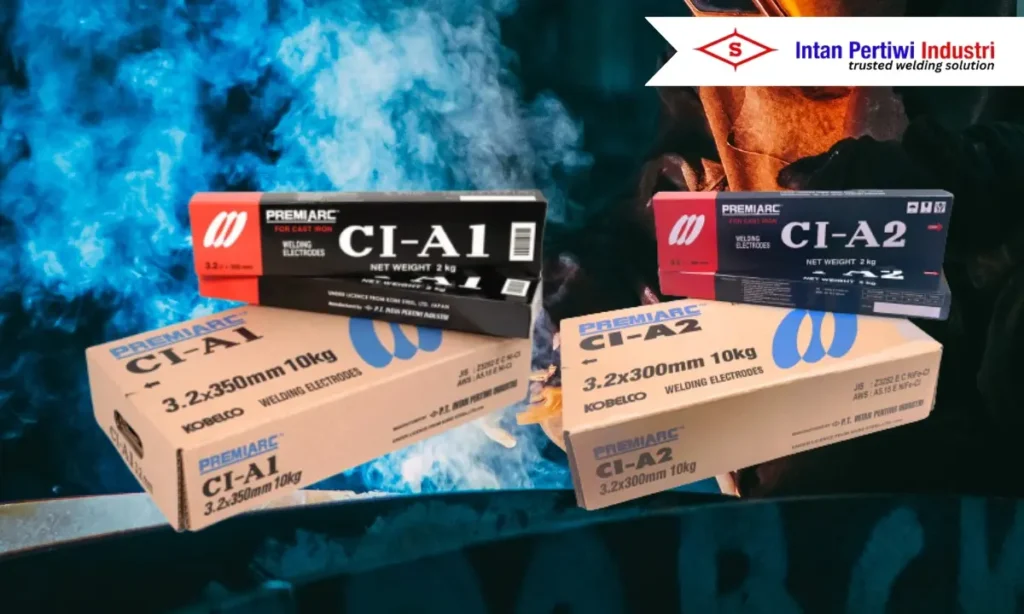
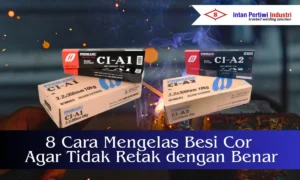
To weld cast iron with electric welding (SMAW), use electrodes that are specifically designed for cast iron, for example CI-A1 Welding Electrode or CI-A2 Welding Electrode, then keep the current low and stable.
6. Perform preheat and control interpass temperature
Preheat helps reduce thermal shock and reduces cracking.
Commonly used field guidelines:
Lower preheat for light repairs,
Higher preheat for thick components or structural repairs.
The most important thing is not the exact number, but:
heating should be even around the welding area,
the temperature between the lines (interpass) is maintained so that it does not drop suddenly,
don't let one side be hot while the other side is cold because it creates tension.
If you don't have a thermometer, at least keep some common sense in mind: don't continue welding when the material is "too cold" or when you notice a change in the arc sound that indicates a drastic change in thermal conditions.
7. Use short bead techniques, skip welding, and peening to relieve stress.
Ini bagian inti dari cara mengelas besi cor yang benar dan sering diabaikan.
Recommended technique:
Short beads (stringer beads)
Weld short welds, do not pull long beads in one pull.Skip welding / jump point
Move locations so that heat does not build up in one area.Light peening after each bead
Lightly tap the weld bead while it's still warm to help reduce residual stresses. Do this in a controlled manner, don't over-tap.
Avoid:
weave too wide,
holding heat too long in one spot,
chasing “quick finish” with long beads.
In cast iron, “fast” often ends in cracking.
8. Mandatory slow cooling
Many cracks occur not during welding, but during cooling. Therefore, cooling is a crucial step.
Which must be done:
Let the components cool down slowly.
For thick components or critical repairs, wrap them with heat-insulating material or a medium that slows the cooling rate (e.g., dry sand or a safe insulating material).
What to avoid:
doused with water,
blown by a fan,
placed in a windy place.
Slow cooling gives the structure and stresses time to adjust, so the risk of cracking is drastically reduced.
Example of Quick Work Sequence (Field SOP)
Here's a quick sequence you can stick to your workshop:
Clean thoroughly, remove oil, clean again
Stop-drill the crack tip, make a V/U weld
Determine cold or hot strategy, choose special cast iron electrodes if available.
Low current set, stable arc
Short bead weld, spot jump, light peening per bead
Maintain the temperature between passes (interpass), do not let it suddenly get cold
Finish as needed, do not overgrind while the object is still hot.
Slow cooling until the temperature drops completely naturally
Common Mistakes That Cause Cast Iron Welds to Crack
If you want consistent results, avoid these seven mistakes:
The surface still contains oil/grease in the pores of the cast iron.
No stop-drill on long cracks
Choosing random electrodes without considering cast iron
The current is too large and the beads are too long.
Do not perform peening or stress relief techniques
No interpass temperature control
Accelerated cooling with water/fan/wind
Closing
Properly welding cast iron isn't about "gluing metal together," but about controlling heat and tension. By following the eight steps above, the risk of cracking is significantly reduced, and the repair results are neater and more durable.
If you are dealing with a specific case (thick component, long crack, or difficult position), you can use this article as the basis for an SOP.
For industrial needs, Intan Pertiwi Industri can also help with consultations on selecting consumables and work procedures so that welding results are safer and more efficient according to the application.
Need recommendations for cast iron electrodes that are suitable for your welding material and position? For CI-A1/CI-A2 orders and technical consultations, contact the Intan Pertiwi Industri team.

Cast Iron Welding FAQs
Can cast iron be welded with electric welding?
Yes. Welding cast iron with electric arc welding (SMAW) is the most common method in workshops, but it requires disciplined heat control, short bead lengths, and slow cooling.
Why do cast iron welds often crack?
The most common causes are a combination of high carbon content, excessive heat input, and rapid cooling. Cracks typically occur in the near-weld area (HAZ) where temperatures drop.
Is it necessary to preheat when welding cast iron?
Not always. For minor repairs and cold welding strategies, high preheat is sometimes not necessary. However, for thick components, long cracks, or structural repairs, uniform preheating significantly reduces the risk of cracking.
Can you use regular electrodes for cast iron?
It can be used as an emergency alternative, but the risks are higher. Safe and consistent results are easier to achieve with electrodes specifically designed for cast iron, combined with short beading and slow cooling techniques.