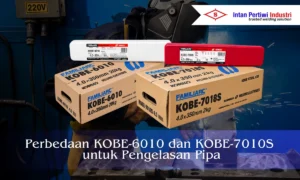
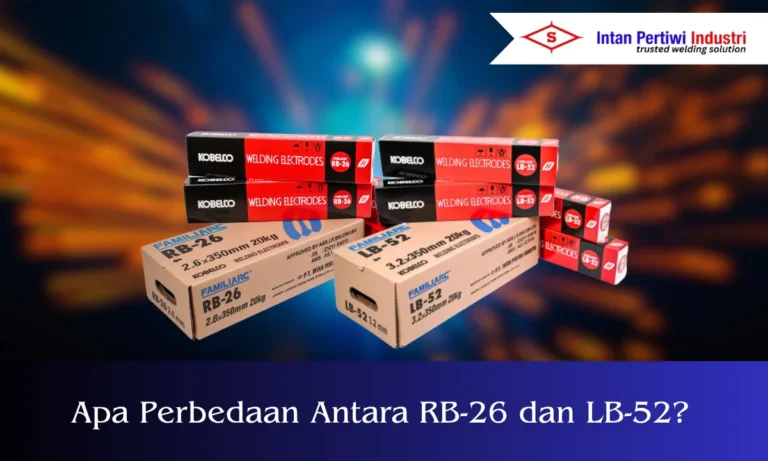
The question “Difference Between RB 26 and LB 52” arises when welders, QCs, and purchasers need to select electrodes that are safe, efficient, and WPS compliant.
Both are KOBELCOs for carbon steel; the RB-26 excels for thin sheet/plate with all-position ease, while the LB-52 family focuses on structural and piping joints with strict hydrogen control.
For a series summary, diameter table, and application recommendations, see kobe welding electrode.
Difference Between RB 26 and LB 52
Here are some differences between RB 26 and LB 52 that you should know, namely:
1. AWS Classification
RB-26: Classified as AWS A5.1 E6013 rutile type. This means a tensile strength level of 60 ksi with user-friendly arc characteristics and easy slag peeling.
LB-52: a member of the low hydrogen basic family listed as AWS A5.1 E7016 on the official KOBELCO list. Related variants in this family include the LB-52U which is also E7016 for pipe roots, and the LB-52-18 which is E7018 for heavy structures.
2. Main Uses
RB-26: favored for butt and fillet on thin plate, with excellent usability in all positions including vertical down. Suitable for general fabrication, light body, and daily maintenance work.
LB-52 family: designed for structures, bridges, pressure vessels, and pipelines in steel grade 490 MPa, emphasizing toughness and fracture resistance thanks to hydrogen control. The LB-52U excels for one-side welding on pipes, while the LB-52-18 is optimized for heavy structures with good AC or DCEP current performance.
3. Tensile Strength (classification level)
RB-26 / E6013: 60 ksi class adequate for light and medium construction in carbon steel.
LB-52 / E7016 and LB-52-18 / E7018: 70 ksi grades, suitable for 490 MPa steel and structural applications demanding higher toughness margins.
4. Current and Polarity
RB-26: AC, DCEP, DCEN, providing flexibility of machine settings and ease of field adaptation.
LB-52U: AC or DCEP with excellent arc stability at relatively low currents for pipe roots. LB-52-18: AC or DCEP for structures.
5. Redrying or Re-drying
RB-26: redrying discipline 70–100°C for 0.5–1 hour, because it is not a low hydrogen electrode so hydrogen control is not as strict as the basic type. Suitable for general warehouses with managed humidity.
LB-52 family: mandatory discipline 300–350°C for 0.5–1 hour to maintain low diffusible hydrogen and prevent hydrogen cracking, especially in thick pipes and structures.
6. Welding Position Notes
RB-26: explicitly supports vertical down, a distinctive advantage of E6013 rutile for fast work on thin plates and down-position joints.
LB-52 family: focuses on all position without vertical down for stable pool control in critical jobs. KOBE welding electrode LB-52U excels in one side welding of pipes, while LB-52-18 targets butt and fillet of heavy structures.
Also Read : How to Choose Welding Electrode Size RB-26
In short
What is the difference between RB 26 and LB 52? KOBE RB-26 welding electrode E6013 for thin plates, friendly arc, vertical down, easy slag release, low redrying, productive and neat. LB 52 E7016 for structures and pipes, 70 ksi strength, low hydrogen, high toughness, need redrying 300 to 350 degrees, choose according to WPS and thickness.
Conclusion
In summary, the differences between RB 26 and LB 52 lie in the flux type, strength class, hydrogen discipline, position, and redrying requirements.
RB-26 is an E6013 rutile that is very operator friendly, flexible across a wide range of polarities, and excels on thin plates including vertical down.
The LB-52 family is a low hydrogen basic in the 70 ksi class for structures and piping, requiring 300–350°C redrying and strict storage controls to maintain toughness and fracture resistance.
If your work focuses on neat productivity in thin plates, start with the RB-26. If you are working with 490 MPa pipes or structures and require high joint integrity, choose the appropriate LB-52 variant such as the LB-52U for pipe roots or the LB-52-18 for heavy structures.
For further information and to order welding electrode products, you can contact us directly through the contact services we have provided.
FAQs
1) Which one to choose: RB-26 or LB-52?
Choose RB-26 (E6013) if you are targeting thin plates, fast working rhythm, smooth vertical down, and neat results; Choose the LB-52 family (E7016/E7018) if you need 70 ksi structural integrity, strict hydrogen control, and toughness for structures, piping, and vessels according to the WPS.
2) Does the RB-26 support vertical down and what about the LB-52?
RB-26 excels for vertical down on fast work and thin plates thanks to its easy-to-flake slag; The LB-52 family focuses all position without vertical down for pool stability at critical joints, with the LB-52U specializing in pipe roots and the LB-52-18 for heavy structures.
3) How do the RB-26 vs LB-52 redrying rules work and why is it important?
RB-26 is sufficient 70–100°C for 0.5–1 hour because it is not low hydrogen; LB-52 family requires 300–350°C for 0.5–1 hour to suppress diffusible hydrogen, prevent hydrogen cracking, maintain toughness, and ensure WPS compliance in thick pipes/structures.