
Welding electrode for Hard Coating is designed for re-coating and hardening of surfaces that experience high wear, with durable and strong weld results.
Hard plating is a welding technique to build a protective layer on a metal surface to make working components last longer.
The goal is simple but important, namely to withstand abrasion, erosion, friction and repeated impacts to reduce downtime and lower maintenance costs.
By selecting the right welding electrode, the service life of production equipment increases and productivity remains stable.
Surfaces wear out more quickly due to friction against materials such as sand, stone, or ore.
The edges of work tools often develop micro-cracks due to repeated blows or impacts.
Components operate at high speeds resulting in particle erosion.
There is a combination of wear and impact with medium working temperatures.
The cost of replacing spare parts is high so a coating strategy is more economical.
Longer component life so maintenance schedules are less frequent.
Consistency in the quality of production results because the wear dimensions are more controlled.
Savings on spare parts procurement costs and production downtime costs.
Flexibility of restoring worn components so they do not always need to be replaced.
Ease of subsequent reconditioning as the old layer can be removed and rebuilt.
Match your choice to the dominant wear mechanisms at your jobsite. Here's a quick guide to three top products in this category.
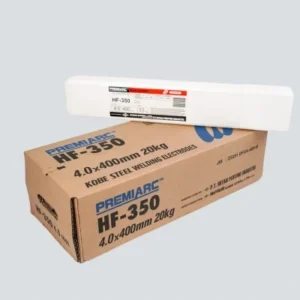
Suitable for components subjected to particle friction and moderate impact. This option is often used on loader buckets, teeth, and runners, which require a tough yet easily repairable coating.
Need a wear-resistant coating for moderate impact loads? Check out the HF 350 hardfacing electrode
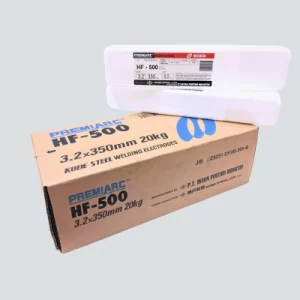
Recommended for high-friction, low-to-medium impact areas, such as chutes, screw feeders, and conveyor friction surfaces. The resulting coating is hard and stable, significantly reducing wear rates.
For high abrasion areas, consider the HF 500 hardfacing electrode
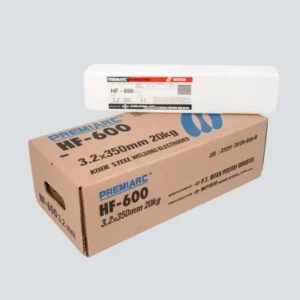
The choice for extremely abrasive, low-impact conditions, such as liners, guide plates, and sharp material contact surfaces. Provides superior wear resistance, allowing for extended maintenance intervals.
For maximum wear resistance in extreme environments, check out HF 600 hardfacing electrode
Mining and quarry on bucket, lip, and side cutter.
Cement plant on chute, fan blade, and housing.
Sugar factory on shredder, cane knife, and diffuser component.
Palm oil mill on screw press, digester arm, and ripple mill.
Power generation on coal feeder and ash handling.
Steel industry on roller guides and pushers.
To understand the differences between KOBELCO product classes and codes, visit the KOBE welding electrode guide page and then return to this category to select the appropriate HF series.
Identify the dominant mechanism, whether dry abrasion, particle erosion, or impact.
Map operating temperatures and thermal cycle frequencies.
Check base metal compatibility to control dilution.
Determine the target coating hardness and required thickness.
Plan welding sequence, bead pattern, and cooling strategy.
Surface preparation is clean from rust, paint, oil and scale.
If necessary, create a support layer with soft steel wire to dampen the stress.
Use current according to diameter and keep the arc length stable to control penetration.
Arrange the beads in thin layers so that the heat is evenly distributed.
Allow a cooling gap between coats to prevent cracking.
Finishing by grinding as necessary without damaging the layer profile.
Reduced spare parts consumption on critical components.
Production downtime is shorter due to less frequent maintenance cycles.
Operating costs are reduced due to longer reconditioning intervals.
Production line output is more stable because wear is controlled.
Please describe your work conditions, base materials, and key wear points. Our technical team is ready to recommend the most suitable electrode, along with current settings and bead patterns, for your job site.