
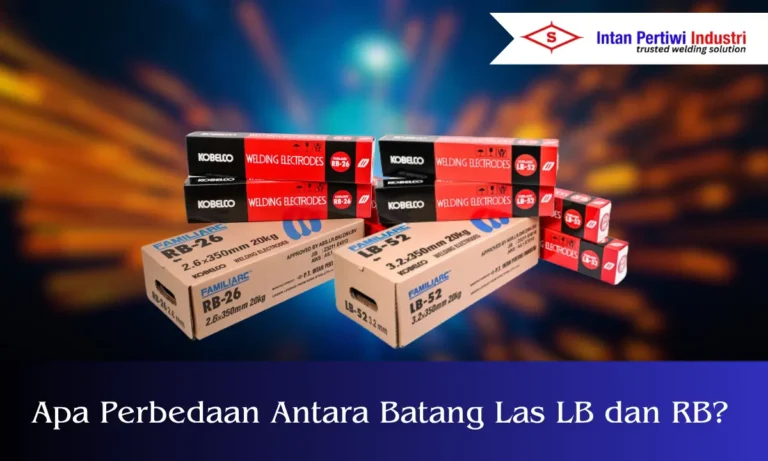
The difference between LB and RB welding rods often determines the quality of joints in workshops and on projects. RB E6013 excels in easy starting and clean finishing for thin to medium-thin plates, while LB E7016 is chosen when toughness and low-hydrogen control are required in load-bearing joints.
In workshops and projects, the choice often boils down to two popular series: RB for the E6013 class and LB for the E7016 class. RB is known for being beginner-friendly and versatile, while LB is chosen when the job demands higher strength and toughness of the weld.
This article guides you to quickly choose according to your work needs.
Difference between LB and RB Welding Rods
LB is a low hydrogen electrode of class E7016 for joints requiring toughness and lower risk of cracking.
RB is an E6013 grade rutile electrode that is easy to ignite, slag release, and suitable for general fabrication as well as thin to medium plates.
When to Choose RB E6013?
General fabrication in the workshop with neat and fast targets
Thin to medium plates that require heat control
Daily repairs, tack welds, and stitch welding
Situations that require an easy bow restart
AC and DC machines with limited no-load voltage
When to Choose LB E7016?
Steel structures that carry loads and require toughness
Pipes, frames, pressure components and critical connections
Projects requiring low hydrogen control
Strict implementation of WPS and quality inspection
Positive polarity DC or AC machines with adequate no-load voltage
Technical Comparison Table
| Aspect | RB E6013 | LB E7016 |
|---|---|---|
| Type of membrane | Rutile | Low hydrogen |
| Character arc | Easy to light, smooth, beginner friendly | Steady and focused connection quality |
| Spatter and slag | Low spatter, quick release of slag | Controlled spatter, slag requires disciplined cleaning |
| Welding position | All positions, vertical down are possible under the right conditions. | All positions, usually vertical up for control of results |
| Connection strength | Adequate for general fabrication | Higher with better toughness |
| Main application | General workshop, thin to medium plate | Structures, pipes, pressure components |
| Polarity | AC and DC | DC positive polarity and AC if OCV is adequate |
| Storage | Store dry in a closed container | Need humidity control, redry according to the guide |
| Typical current Ø 2.6 mm | Around 60 to 90 A | Around 70 to 100 A |
| Typical current Ø 3.2 mm | Around 90 to 130 A | Around 100 to 140 A |
| Typical current Ø 4.0 mm | Around 120 to 170 A | Around 130 to 180 A |
Note: Current range varies depending on brand, position, gap, and connection conditions. Perform a short test before production.
Conclusion
In summary, RB E6013 is suitable for daily work that requires easy starting, neat finishing, and heat control on thin to medium plates, while LB E7016 is chosen when the joint is under load and demands toughness and low hydrogen control.
Make your selection based on design load, material type, weld position, and machine capabilities. Keep RB in dry storage and implement humidity and redry control according to LB guidelines. Always perform short tests and follow the WPS for consistent results.
FAQs
When should you choose RB E6013?
Choose the RB for everyday workshop work, light repairs, tack and stitch, and when you need easy bow starts on thin to medium plates.
When should you choose LB E7016?
Choose LB for load-bearing structures, piping, compression components, or projects requiring low hydrogen control and stringent quality procedures.
Can these two types be used in all positions?
Both can be used in all positions. RB can be used on vertical descents with proper setup. LB is generally more stable on vertical ascents to maintain joint quality.
Does LB E7016 require re-drying?
Not always, but LB is sensitive to humidity. If the packaging has been open for a long time or the electrodes feel damp, dry them according to the manufacturer's instructions. RB should simply be kept dry in a closed container.