
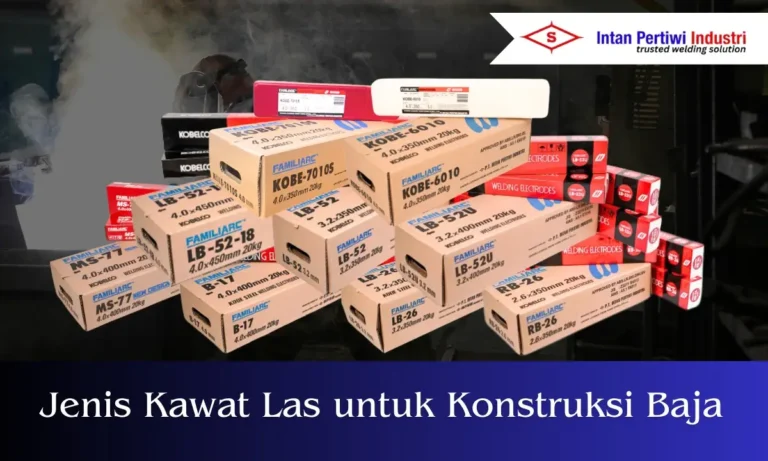
Welding Electrode for steel construction determines whether the WF frame, H beam, and bracing connections are truly strong, neat, and pass inspection without rework.
Before selecting a product, make sure you understand the project requirements from AWS class, WPS demands, welding positions, to the risk of cracking in the structure.
Table of Contents
ToggleIntroduction
In structural projects such as warehouses, factories, bridges, towers, and even WF and H-beam steel frames, welding involves more than simply "gluing" two materials. It must pass inspection, maintain consistent quality, and comply with project procedures.
Therefore, the selection of Welding Electrode for Steel Construction needs to consider the type of steel, welding position, material thickness, tensile strength requirements, and the risk of cracking.
This article summarizes how to select the relevant electrode for construction needs, while also helping field, QC, and procurement teams find common ground when comparing types, AWS standards, and their compatibility with applicable WPS.
See Also: KOBE Welding Electrode Catalog
What is Welding Electrode?
Welding Electrode is an additional material that melts during the welding process to form weld metal and join two pieces of material.
In steel construction, the term “welding Electrode” often refers to a flux-coated SMAW electrode. Flux helps stabilize the arc, forms a protective slag, reduces oxidation, and influences weld characteristics such as weldability, bead appearance, and defect resistance.
Because structural welding usually demands consistency, the selection of welding Electrode must be in line with project specifications, AWS standards, and parameters set out in the WPS such as current, polarity, position, and joint preparation.
Types of Welding Electrode for Steel Construction
In practice, the selection of Welding Electrode for Steel Construction can be grouped into three main needs. These are:
- First, general carbon steel work for fabrication and installation which requires a fast and neat process.
- Second, structural needs that prioritize crack resistance, usually use the low hydrogen type.
- Third, the need for root passes or certain fieldwork that relies on cellulose for penetration and control of open joints.
Below are common electrode options used in construction, complete with context for when to choose them to ensure both technical and purchasing decisions are made.
1. RB-26 AWS A5.1 E6013 Welding Electrode
RB-26 welding Electrode is a versatile choice for general carbon steel work in the workshop and field.
Its characteristics are known to be easy to ignite, stable, and help produce neat beads, making it suitable for light to medium fabrication, fillet welding, and assembly work that requires productivity.
For steel construction, RB-26 is often used when the priority is ease of workmanship, good finishing, and fast work rhythm, especially for non-critical work that still follows procedures.
To be on target, use RB-26 when the material is classified as mild steel, the connection does not require high crack resistance as low hydrogen, and the work position requires an operator-friendly electrode.
For jobs that are highly sensitive to hydrogen cracking or heavy structures, the engineering team will typically direct to the low hydrogen series.
2. MS-77 AWS A5.1 E6013 Welding Electrode
MS-77 is in the E6013 class which is widely chosen for general carbon steel construction needs because its welding characteristics are stable and easy to control.
In the fabrication of frames, bracing, mountings, and repetitive workshop work, MS-77 helps maintain the consistency of the weld line appearance and reduces rework because the process is relatively comfortable for the operator.
The MS-77 is the right choice when the project requires large welding volumes on general carbon steel and the team is pursuing a measurable work speed.
If more stringent procedural requirements are encountered in the field, such as crack resistance and hydrogen control, low hydrogen series such as E7016 or E7018 are usually a safer option according to the WPS.
3. B-17 AWS A5.1 E6019 Welding Electrode
B-17 is in the E6019 class which is generally used for carbon steel welding and fabrication work that requires relatively good deposits and stable operations.
In construction environments, B-17 is often considered for fillet welds on structures, brackets, and joints that demand solid filling and a clean appearance.
Use B-17 when the primary need is productivity and consistency on carbon steel, while ensuring parameters follow the WPS.
For structures that require higher crack resistance, especially in thicker materials or high restraints, the low hydrogen series remains the primary reference.
4. LB-26 AWS A5.1 E7016 Welding Electrode
LB-26 welding Electrode is a low hydrogen electrode of class E7016 which is widely used in structural construction due to its focus on toughness and resistance to cracking.
On main frames, joints with high restraints, and work that has the potential for rapid cooling, hydrogen control is a critical point.
This is where LB-26 is relevant as a Welding Electrode for Steel Construction that demands reliable joints.
LB-26 is suitable for when the project requires stricter structural quality, and the QC team emphasizes the prevention of crack defects.
In its implementation, aspects of electrode storage, flux conditions, and humidity control need to be maintained according to internal project procedures so that the benefits of low hydrogen are truly achieved.
5. LB-52 AWS A5.1 E7016 Welding Electrode
LB-52 welding Electrode is also in the E7016 low hydrogen class and is often used as a reference in structural work due to its stable performance for joints that require strength and durability.
In heavy steel construction, erection work, and critical joints that must pass inspection, low hydrogen electrodes help reduce the risk of cracks that are detrimental to project costs and time.
Select LB-52 when the structure is operating under high loads, the connections are in major sections, or the project specifications call for E70 low hydrogen grade.
In terms of process, ensure weld preparation, surface cleanliness, and welding heat control follow the WPS to ensure consistent results from root to cap.
6. LB-52-18 AWS A5.1 E7018 Welding Electrode
LB-52-18 is a low hydrogen electrode of E7018 grade which is very commonly mentioned in structural specifications because it emphasizes durability, deposit quality, and arc characteristics that support neat results in structural welding.
In many projects, E7018 is selected to meet stringent quality standards in carbon steel structural joints, including when better control of hydrogen-related defects is required.
LB-52-18 is appropriate for use when the WPS is oriented to class E7018 and the project demands consistent connection quality for visual inspection and other tests.
In the field, disciplined electrode storage and humidity control are key to maintaining the low hydrogen character as required by procedures.
7. LB-52U AWS A5.1 E7016 Welding Electrode
LB-52U welding Electrode is a low hydrogen E7016 variant that is often chosen for needs that emphasize control in the initial stages of the joint, especially when the root pass requires good stability and quality.
In steel construction involving procedural joints, these electrodes help maintain quality from the start so that subsequent layers can be executed more safely and consistently.
The LB-52U is suitable when the welding engineer team wants low hydrogen character with good control for a specific stage in the welding sequence.
Always refer to the project WPS regarding polarity, position, and parameters, as these decisions affect final quality and productivity.
8. KOBE-6010 AWS A5.1 E6010 Welding Electrode
KOBE-6010 is an E6010 grade cellulose electrode known for its strong penetration and root pass performance on open joints, especially in field work.
In the context of steel construction, E6010 is relevant when the working method requires good penetration and control at certain joints, for example at pipe joints or joints that demand the typical characteristics of cellulose.
Choose KOBE-6010 when project procedures dictate E6010 and the field team requires penetrating characteristics and the ability to work in dynamic field conditions.
Because cellulose has its own process characteristics, ensure that the operator is experienced and that parameters are adhered to to avoid defects such as undercuts or burn-through.
9. KOBE-7010S AWS A5.5 E7010-P1 Welding Electrode
KOBE-7010S is in the E7010 class which is commonly used for pipe applications and certain field work with penetration and productivity demands in certain positions.
For steel construction projects that have specific fieldwork sections, this electrode can be an option when the WPS requires E7010 and the team needs suitable process characteristics.
The KOBE-7010S is appropriate to consider when project requirements lead to class E7010, for example in jobs that emphasize root passes, open connection control, or fieldwork characteristics according to procedures.
As with other cellulose electrodes, parameter discipline and operator skill are crucial to the results.
Conclusion
Choosing the right Welding Electrode for Steel Construction is not about finding the “strongest”, but rather the one that best suits the material, work position, thickness, welding sequence, and WPS standards of the project.
For general carbon steel work, grades E6013 such as RB-26 and MS-77 are often chosen due to their ease of use and productivity. For structures requiring crack resistance, low-hydrogen series such as LB-26, LB-52, LB-52-18, and LB-52U are the primary options.
For certain field needs that require cellulose, KOBE-6010 and KOBE-7010S can be relevant according to the procedure.
If you want the most suitable recommendation for your project, please send us the details of the material, thickness, welding position, and WPS standard used, then the intanpertiwi.co.id team will help you determine the right KOBELCO product while checking stock availability and the best offer.
FAQs
1. What welding Electrode for steel construction is the safest for structural joints and has minimal risk of cracking?
For structural joints that require crack resistance and hydrogen control, low hydrogen electrodes such as LB-26, LB-52, LB-52-18, and LB-52U are generally the preferred choice, while still following the project's WPS.
2. What is the main difference between E6013 electrode and E7016 or E7018 for steel construction?
E6013 such as RB-26 and MS-77 focuses on weldability and productivity for general carbon steels. While E7016 and E7018 such as LB-26, LB-52, LB-52-18, and LB-52U are low hydrogen grades that are more intended for structural needs with stricter quality requirements.
3. When should you choose KOBE-6010 or KOBE-7010S for steel construction work?
Both are usually chosen when the WPS requires a cellulose electrode for a specific need such as a root pass on an open joint or field work with specific penetration and technique demands, especially for work involving pipes or special joints.
4. How to ensure that the welding Electrode selection complies with the AWS and WPS standards of the project?
Check the AWS classification of the electrode you choose and compare it to the WPS requirements, including welding position, polarity, current, joint type, and material preparation. If the WPS calls for low hydrogen, use the low hydrogen series and follow proper storage procedures.
5. Why is electrode storage and condition important for the results of steel construction welding?
Because flux and electrode moisture conditions affect arc stability and the risk of defects, especially with low-hydrogen electrodes, proper storage helps maintain consistent weld quality and reduces the potential for cracking or porosity.